

How to Choose a Labeling machine
October 12 ‘2026
How to Choose a Labeling Machine for Bottles, Jars and Flat Packaging
When labels are applied by hand, working time and positioning consistency depend on the operator. As packaging volumes increase or products change frequently, choosing the right labeling machine can make the process easier.
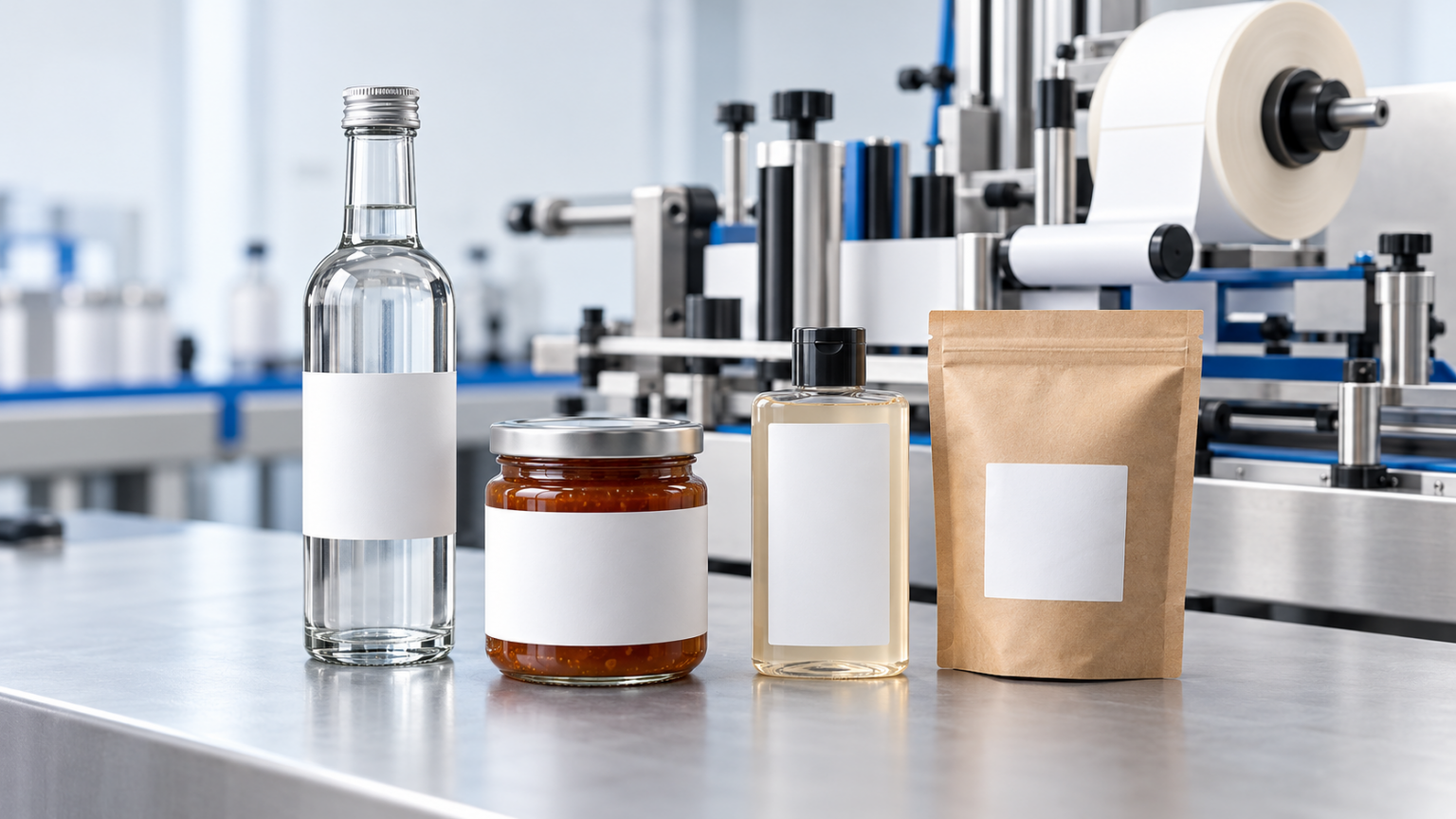
The first question is what type of packaging you need to label. Next come the label dimensions, the required volume and how the work will be organized. Here is how to approach the choice.
1. Start with the Shape of the Packaging
Cylindrical Bottles, Jars and Small Containers
For cylindrical containers, Diktech offers the STS808 and STS818. These machines rotate the container while applying the label.
Both models operate on the same principle. The STS818 is the option for wider labels and taller containers.
| Specification | STS808 | STS818 |
|---|---|---|
| Maximum label width | 150 mm | 220 mm |
| Container length — height when upright | 80–240 mm | 30–300 mm |
| Container diameter according to the technical specifications | 20–160 mm | 20–160 mm |
Also consider the surface where the label will be applied. If the container is tapered or has raised features, send a sample so that the application can be assessed.
Flat Surfaces and Irregular Shapes
Applying a label to a flat or oval surface calls for a different operating principle.
The STS810 is designed for these applications. The item is placed on a platform. For irregular shapes, a custom fixture may be needed to hold it in position.
The choice depends on the specific labeling area. Access to the surface, the stability of the item and the label dimensions all need to be checked.
Pouches and Bags
The STS816 is used for thin pouches and bags. The operator feeds the pouch manually, and the machine takes it in and applies the label.
According to the technical specifications, the pouch must be less than 5 mm thick. For pouches, it is therefore important to specify whether labeling will take place before or after filling and to send a sample in the condition in which it will pass through the machine.
2. Check the Label and the Roll
The label dimensions must suit both the machine and the selected area on the packaging. The width of the label web and the width of the label itself are different specifications.
Before choosing a machine, specify:
- label width and length;
- material and transparency;
- roll diameter and core diameter;
- gap between labels;
- winding direction and artwork orientation.
For transparent labels, the way the machine detects each label also matters. The models described here use an ultrasonic label sensor. Even so, testing with the actual roll is useful when setting up the specific application.
3. One Label or Front and Back Labels?
The STS808 and STS818 can apply front and back labels symmetrically to a cylindrical container when both labels are supplied on the same roll.
If a label needs to be positioned relative to a seam, handle, raised feature or another characteristic, mention this in your initial enquiry. That requirement needs to be assessed separately.
4. Match the Machine to Your Daily Workflow
The stated output is a starting point. With a semi-automatic machine, the operator is involved in feeding or positioning the packaging, so the result also depends on how the work is organized.
Specify how many packages you process each day, how many different sizes you use and how often you change rolls. For larger, consistent production runs, automatic labeling on a conveyor may also be worth considering.
Which Model Should You Consider First?
| Your application | Starting point |
|---|---|
| Cylindrical containers and labels up to 150 mm wide | STS808 |
| Cylindrical containers with wider labels or greater height | STS818 |
| A flat or oval labeling area | STS810 |
| Thin pouches and bags | STS816 |
This table is a guide. The final choice depends on the dimensions, material and a test with your packaging.
Send Samples for Selection and Testing
To help us recommend a suitable solution, send photographs and dimensions of the packaging, the label dimensions, the required position and the expected daily volume. Testing requires actual packaging and a roll of labels.
Contact Diktech to discuss your application and arrange a possible test.