

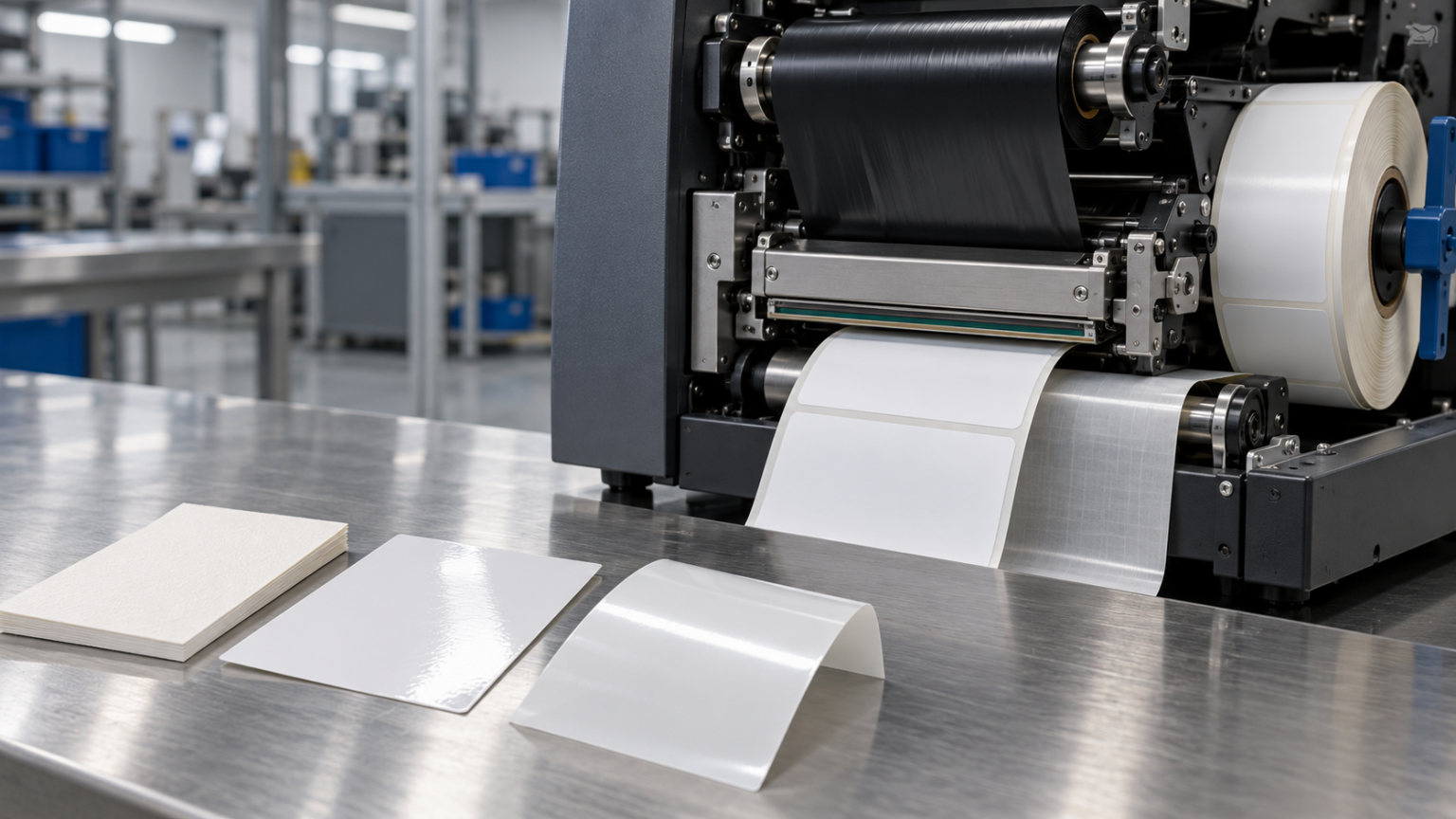
Which thermal transfer ribbon is suitable for your labels?
October 19 ‘2026
When printing with a thermal transfer printer, the choice of ribbon affects the quality and durability of the print. An unsuitable combination can result in faded or blurred text, barcodes that rub off upon contact, and the need for reprints.
The golden rule is: **match the thermal transfer ribbon to the label material and coating, as well as the conditions to which the print will be exposed.**
How does thermal transfer printing work?
A thermal transfer printer uses a printhead to heat a thermal transfer ribbon. The ink layer on the ribbon is then transferred onto the surface of the label.
Unlike direct thermal printing, thermal transfer printing typically requires a ribbon. These ribbons can be wax-based, wax-resin based, or resin-based.
Main types of thermal transfer ribbons
Standard Wax Ribbon
A wax ribbon is an economical choice for printing on paper labels—specifically when the print will not be subjected to heavy friction, chemicals, or prolonged exposure to moisture and heat.
It is suitable for a wide range of general applications, such as address labels, courier labels, warehouse labels, and price tags.
Premium Wax Ribbon
Premium wax ribbons are also primarily used with paper labels. Depending on the specific product, it may offer better print density or higher throughput compared to a standard wax ribbon.
The term “Premium” does not denote the same characteristics across all manufacturers. Therefore, please check the product specifications for compatible materials and recommended settings.
Standard Wax-Resin Ribbon
A wax-resin ribbon combines wax and resin. It generally provides better resistance to smudging and scratching than a wax ribbon and is used on coated paper and certain synthetic labels.
It is suitable for scenarios where the label will be touched or handled frequently, but where the highest level of durability is not required.
Premium Wax-Resin Ribbon
This type of ribbon is suitable for applications requiring a more durable print on coated paper or compatible synthetic materials. The specific level of durability depends on the ribbon’s composition and the label’s surface layer.
Multi-Purpose Resin Ribbon
Resin ribbons are primarily used with synthetic labels and in applications where the print must withstand significant friction, heat, or chemicals. They require precise compatibility between the ribbon and the label surface.
“Multi-Purpose” refers to a specific product type; it is not a guarantee that the ribbon is suitable for every synthetic material. Check the technical specifications and perform a test print.
Which ribbon should you choose based on the label material?
| Label Material | Recommended Starting Ribbon | When to Choose a More Durable Ribbon |
|—|—|—|
| Matte, uncoated paper | Standard wax | Premium wax or wax-resin, if the print is subject to frequent rubbing or handling |
| Matte, coated paper | Wax or standard wax-resin (depending on the coating) | Premium wax-resin if higher durability is required |
| Glossy paper | Standard or premium wax-resin | Premium wax-resin for better resistance to smudging and scratching |
| Matte polypropylene (PP) | Wax-resin (if compatible with the label) | Resin ribbon for higher durability and a longer-lasting print |
| Glossy polypropylene (PP) | Wax-resin or resin (depending on the coating) | Resin ribbon for greater resistance to abrasion, chemicals, or moisture |
| Polyester (PET), polyethylene (PE), or PVC | Resin ribbon specifically designed for the material | Check specifications regarding required resistance to chemicals, temperature, moisture, and environmental conditions |
This table serves as a guide, not a universal guarantee. Two labels described as “glossy polypropylene” may have different surface coatings and require different thermal transfer ribbons.
What else should you check before purchasing?
**Conditions of use.** Will the label be kept in a warehouse, or will it be exposed to sunlight, moisture, heat, friction, or cleaning agents? The more demanding the environment, the more important it is to verify the durability of the entire combination: the label, the ribbon, and the printer settings.
**Printer compatibility.** Beyond the composition of the ribbon, other factors matter: the printer model, the type of printhead, the width and length of the ribbon, the core diameter, and which side the ink layer is on (ink-in or ink-out).
**Test printing.** Before ordering a large quantity, print a test label on the actual material. Check that the text and barcode are clear, and ensure the print does not smudge or rub off. For critical applications, it is advisable to test the label under the actual conditions of storage and use.
In brief
For standard paper labels, start with a standard wax ribbon.
For glossy or coated paper, a wax-resin ribbon is often suitable.
For polypropylene and other synthetic materials, check surface compatibility; a resin ribbon is typically used when higher durability is required.
When making your final selection, consider the specific material, the printer, and the environment in which the label will be used.
If you are unsure which thermal transfer ribbon is appropriate, have your printer model, the exact label material, and a brief description of the usage conditions ready. The Diktech team can assist with your selection and recommend a test print.